













Ducted vs. Ductless: Which One Should You Get?
This is the first decision to make, and it shapes everything else about the install. Both styles have their place. The right one depends mostly on what your kitchen will actually allow.
Ducted Range Hoods
The better-performing choice. A ducted hood pulls cooking smoke, grease, and moisture out of the kitchen entirely, venting through a duct to either the roof or an exterior wall. They cost more to install because the ductwork has to be sized, sealed, and routed properly, but they handle high-output cooktops and gas ranges far better than recirculating units. They also keep grease and humidity off your cabinetry over time, which is harder to put a price on.
Ductless (Recirculating) Range Hoods
The fallback option for kitchens where running ductwork outside isn't practical. Common in condos, basement suites, and interior kitchens with no exterior wall above the cooktop. A ductless hood pulls air through charcoal filters and pushes it back into the kitchen. They handle moderate cooking fine but struggle with high-output stoves, gas ranges, and heavy frying or wok cooking. Filters need replacing every six months or so to keep the unit working properly.
Convertible Hoods
A lot of modern range hoods can be installed either ducted or ductless using the same physical unit and a conversion kit from the manufacturer. Useful if your kitchen could go either way, or if you're planning a future renovation that might change your venting options. We can install in either configuration and talk through which makes sense for your specific kitchen during the quote.
Sizing the Hood for Your Cooktop
Range hoods are rated in CFM, which stands for cubic feet of air moved per minute at full speed. Picking the right CFM is one of the most important calls you'll make. Undersized hoods can't keep up with the cooking. Oversized hoods waste energy and can pull conditioned air out of the house faster than it can be replaced.
Electric and Induction Cooktops
For a 30-inch electric or induction cooktop, 250 to 400 CFM is usually plenty. Lower numbers handle light cooking. Higher numbers cover frequent stir-frying or heavy use. The hood should be at least as wide as the cooktop, ideally an inch or two wider on each side for better capture. Don't pair a 30-inch cooktop with a smaller hood.
Gas Cooktops
Gas produces more heat, smoke, and combustion byproducts than electric or induction, so the CFM requirement goes up. The standard rule across the industry is 1 CFM per 100 BTU of total burner output. Most residential gas cooktops run 40,000 to 60,000 BTU total, which puts you in the 400 to 600 CFM range. Pro-style gas ranges from Wolf, Viking, or Thermador can total 65,000 BTU or more and need hoods in the 700 to 1200 CFM range to keep up.
Induction Is More Forgiving
Induction cooking produces less ambient heat, smoke, and moisture than gas or even electric coil cooktops, so a slightly lower CFM hood will usually do the job. That said, induction's high-output sear function can produce surprising amounts of smoke when cooking high-fat foods at maximum heat. Don't undersize too aggressively just because the cooktop is induction.
Island Hoods Need More Power
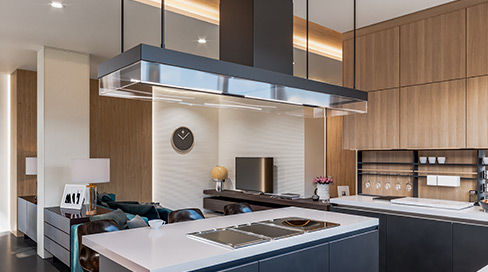
Island hoods don't have a back wall to help funnel air upward, so they need 20 to 30 percent more CFM than the equivalent wall-mounted hood. A 600 CFM hood that would handle a wall-mounted gas range comfortably might struggle on an island install. Plan for that when you're shopping.